

How to Choose a Kayak Sprayskirt

Northwest Outdoor Center’s guide to finding the right sprayskirt for your kayak and paddling style


Choosing a kayak sprayskirt comes down to three things: where you paddle, how dry you need to stay, and how secure you want the fit.
If you’re paddling calm lakes in the summer, you don’t need anything complicated. But if you’re dealing with wind, boat wake, or cold water — which is most of the year in the Pacific Northwest — the right sprayskirt makes a difference in comfort and safety.
This guide covers the main skirt types, how sizing works, and the specific options we carry at Northwest Outdoor Center.
Which Sprayskirt Should You Choose?
If you want a quick answer before diving into the details:
Calm lakes / warm weather | Nylon sprayskirt |
General touring / PNW year-round | Hybrid sprayskirt |
Rough water / waves / rolling | Neoprene sprayskirt |
Large recreational cockpits | Half skirt |
If you’re unsure, most paddlers around Seattle end up happiest with a hybrid. It balances comfort, dryness, and ease of use without the full commitment of neoprene.
Terminology

Deck — the part that attaches to and covers the cockpit opening
Tunnel / Tube — the part that goes around your midsection
Grab Loop — the loop at the front of the deck that you pull to release the skirt
Coaming — the raised lip around the cockpit that the deck stretches over
Types of Sprayskirts
Nylon (Best for Calm Water)

Lightweight, affordable, and easy to put on. Nylon skirts are a solid choice if you’re paddling flat water like Lake Union on a nice day and your main goal is keeping splash out of the cockpit. Less expensive than neoprene, but they won’t seal reliably in rough conditions and won’t last as long with heavy use.
Good for: casual lake paddling, warm weather, beginners
Not ideal for: breaking waves, rolling, or anything rough
Hybrid (Best All-Around Option)
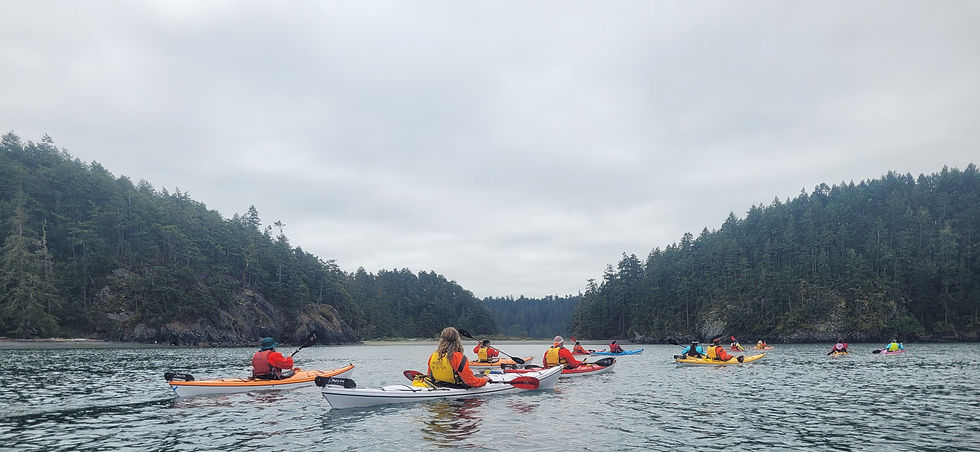
Hybrid skirts pair a neoprene deck (the part that seals to the kayak) with a nylon or breathable tunnel. You get a snug, secure fit on the kayak without the difficulty of pulling on a full neoprene tunnel. For most sea kayakers paddling in the Pacific Northwest, a hybrid is the sweet spot.
Good for: Puget Sound touring, mixed conditions, paddling year-round
Not ideal for: serious surf or advanced rolling where every drop matters
Neoprene (Best for Rough Water)
Neoprene skirts are built for performance. They create a tight, watertight seal that holds in waves, boat wake, and during a roll. The all-neoprene construction adds insulation around your lower body, keeping you warmer when the water is cold. The tradeoff is that they’re harder to get on and off.
Good for: open coast, surf, rolling practice, advanced paddlers
Not ideal for: beginners or casual summer paddling — if you’re not sure you need neoprene, you probably don’t yet
Half Skirts (For Recreational Kayaks)
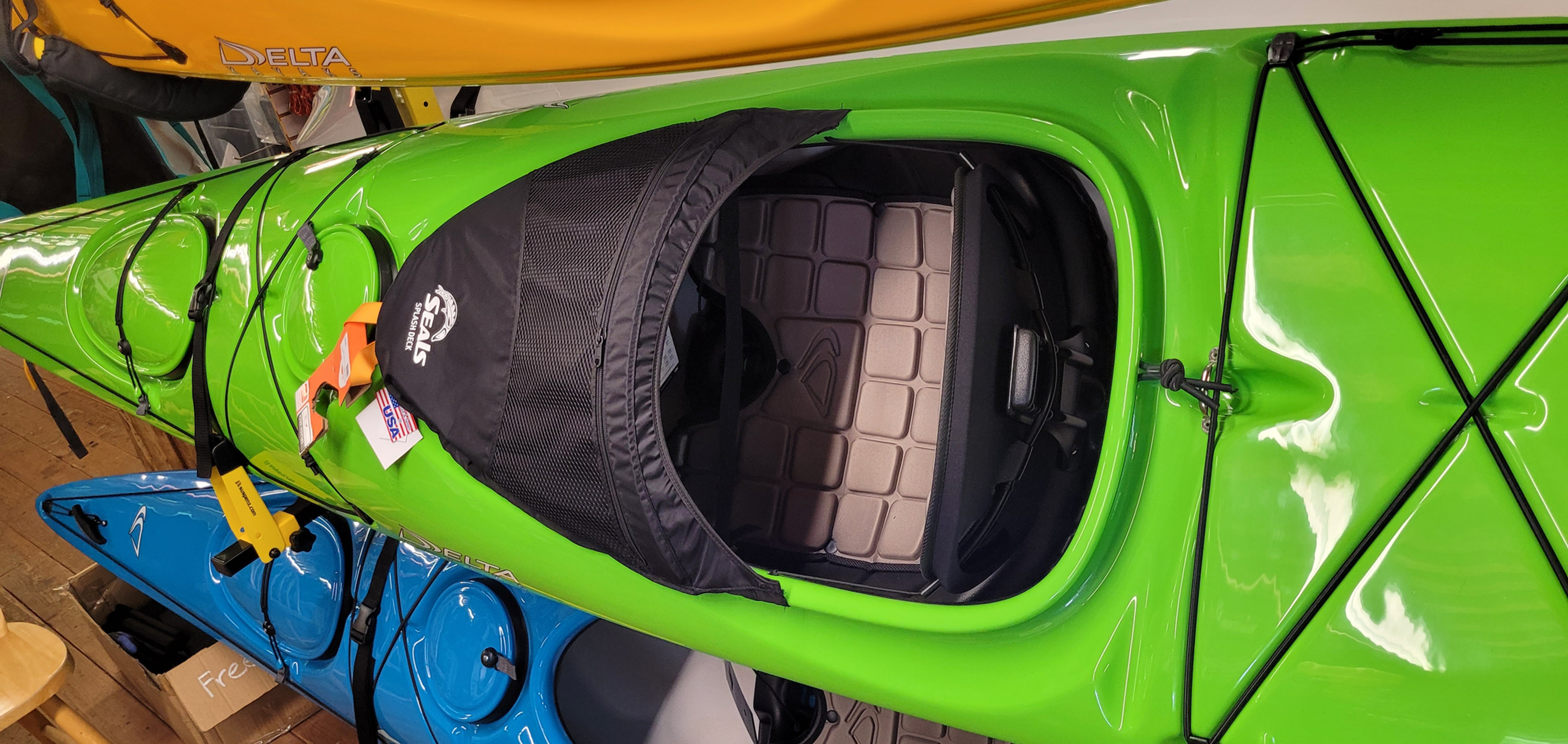
Half skirts cover only the front portion of the cockpit. They’re designed for large-cockpit recreational kayaks and don’t wrap around your body at all. Fine for calm conditions when you want basic splash protection without the feeling of being enclosed.
Good for: rec kayaks, warm casual paddling, paddlers who feel claustrophobic in a full skirt
Not ideal for: anything rough or anywhere you’d want a real seal
Sprayskirt Comparison
Here’s how the four main types stack up at a glance:
Type | Best For | Pros | Cons |
Nylon | Calm lakes, warm weather | affordable, lightweight | can come off in moderate conditions |
Hybrid | General touring, PNW year-round | secure deck, comfortable tunnel | can be warm on sunny days |
Neoprene | Rough water, waves, rolling | driest seal, stays on in rough conditions | harder to get on and off |
Half Skirt | Rec kayaks, casual paddling | no tunnel, cheap, easy | minimal protection |
How to Put On a Sprayskirt
The sequence is: back first, then front, then finish the sides.
If you’re wearing a neoprene tunnel, stepping into the skirt is usually easier than pulling it over your head — though it depends on your body type.
Hook the back of the skirt around the coaming behind you, using both hands, until it sits evenly at hip height.
Place your thumbs on top of the skirt a few inches from the grab loop on each side and hook your fingers underneath. Move your hands forward to maintain tension.
Don’t grip too close to the grab loop — holding it there pulls the back off the coaming.
With the grab loop on top, stretch the front of the skirt onto the coaming, then finish the sides.
If the skirt has grip strips on the underside, stretch forward and press the strips down onto the coaming with your forearms before securing the front.
Safety: Always Practice Removing Your Skirt First

Whenever you’re in an unfamiliar kayak, put on your sprayskirt and practice removing it before you paddle into deep water. Grasp the grab loop, push forward, then bend your elbow. This tells you exactly how much effort it takes — and gives you a much clearer head if you ever need to wet exit in a hurry.
A skirt you can’t quickly release is a safety hazard. If your kayak has a sharp coaming edge, make sure you can pop the skirt reliably before relying on it on the water.
How to Find Your Size
Sprayskirt sizing has two independent dimensions: deck size (cockpit fit) and tunnel size (body fit). You need the right match for both.
How to Size a Sprayskirt (Quick Version) |
1. Find your kayak’s make and model (on the hull near the bow or stern) |
2. Use the manufacturer fit list to match your kayak to the right deck size |
3. Choose your tunnel size based on waist measurement or pants size |
4. When in doubt — size up |
Step 1: Identify Your Kayak
Look at your boat — the model name and manufacturer are usually on the hull near the bow or stern.
Step 2: Find the Right Deck Size
Use the manufacturer’s fit list to match your kayak to the correct deck size:
Seals may recommend different deck sizes for nylon versus neoprene skirts. Check the fit list for the specific material you’re ordering.
For IR skirts, you can also measure the circumference of the outer lip of your coaming. If you’re between sizes and want something that goes on without a fight, go up.
Step 3: Find the Right Tunnel Size
Seals nylon and hybrid skirts — based on your widest measurement between waist and sternum, wherever the top of the tunnel sits on your body
Size | Widest Measurement (waist to sternum) |
Low Slender | up to 34" |
Standard | up to ~44" |
Extra Fit | up to ~53" |
Seals neoprene skirts--Some sizes are made to order and come with a customization charge. Those options are shaded in the table below. Measurement is based on your widest measurement between waist and sternum, wherever the top of the tunnel sits on your body.
Size | Midriff Measurement |
XS | 24"-26" |
Small | 27"-29" |
Medium | 30"-32" |
Large | 33"-35" |
XL | 36"-39" |
XXL | 40"-43" |
XXXL | 44"-50" |
Immersion Research neoprene sprayskirts--Sized to your casual pants size. IR tunnels are designed for a snug seal and stretch with use. If you're between sizes, or you're wearing bulky layers like a drysuit underneath, size up.
Size | Waist Measurement (pants size) |
XSmall | 26"-28" |
Small | 28"-30" |
Medium | 30'-33" |
Large | 33"-36" |
XLarge | 36"-40" |
XXLarge | 40"-44" |
Sprayskirt Options at Northwest Outdoor Center
Half Skirt
Seals Splash Deck
Best for: Large cockpit recreational kayaks, casual calm water paddling
The seals splash deck covers only the front portion of the cockpit. It fits the kayak rather than the paddler--you don't wear it. Good for recreational kayakers who want basic splash protection without the feeling of being enclosed.
Benefits | Drawbacks |
|
|
Nylon Sprayskirts
Seals Adventurer
Best for: calm lakes, protected water, occasional use
A straightforward coated nylon sprayskirt for calm water paddling--lakes, protected inlets, easy day trips where you don't expect waves. Easy on the budget, with an adjustable tunnel and removable suspenders. Not built for heavy use.
Benefits | Drawbacks |
|
|
Seals Tropical Tour
Best for: Sea kayak touring in moderate conditions
A waterproof, breathable skirt for light to moderate conditions. Noticeably nicer to wear than standard coated nylon, this skirt is quieter, more substantial, and it won't steam up the cockpit on warm days. A good match for sea kayakers who spend more of their time in less challenging conditions and want something comfortable for longer days on the water.
Benefits | Drawbacks |
|
|
Hybrid Sprayskirts
Seals Sea Sprite
Best for: Pacific Northwest sea kayaking, mixed conditions
The Sea Sprite is our most recommended skirt for sea kayakers in the Pacific Northwest. The neoprene deck provides a snug, secure fit without being harder to get on than a nylon skirt because the bungee is sewn directly onto the deck rather than threaded through a sleeve. Less adjustability but also less fuss: the stretch in both the neoprene and the bungee takes care of the fit when you're using the right size for your kayak.
Benefits | Drawbacks |
|
|
Seals Extreme Tour
Best for: demanding conditions, paddlers who are regularly in rough water
A step up from the Sea Sprite for paddlers who regularly deal with demanding conditions. Thicker neoprene deck and heavier bungee cord means it stays on more reliably and requires more effort to get on.
Benefits | Drawbacks |
|
|
Delta Neo/Nylon Sprayskirt
Best for: Delta Kayaks touring models
Made specifically for Delta Kayaks. Fits all Delta touring models from the 12s though the 17. Does not fir the 10AR or 12AR recreational cockpits or older model delta kayaks with a black coaming.
Benefits | Drawbacks |
|
|
Neoprene Sprayskirts
Seals shocker
Best for: rough water sea kayaking, beginning whitewater
A solid, affordable all-neoprene skirt for sea kayakers in rough water or beginner whitewater paddlers. Offers a tight, reliable seal and is less likely to come off during a roll or from a wave breaking in your lap.
Benefits | Drawbacks |
|
|
Immersion Research Shockwave
Best for: rough water sea kayaking, paddlers looking for durability
Our pick for sea kayakers who spend time in challenging conditions and want something that holds up. Stretchy, well constructed, and backed by a great warranty. The seam placement gives it more stretch than the shocker, and the grip strips keep it in place once it's on.
Benefits | Drawbacks |
|
|
Immersion Research Klingon
Best for: Intermediate-advanced whitewater, rock gardening, surf kayaking
The driest, most secure option in our lineup. The Schoeller™ Dynamic® reinforced front casing, high-tension neoprene-wrapped bungee, and super-sticky silicone grip strips work together to keep this skirt on when conditions are doing their best to remove it. It earns that performance-- it’s also the hardest to get on.
Benefits | Drawbacks |
|
|
Frequently Asked Questions

Do I need a sprayskirt for kayaking?
Not always. On a calm lake in warm weather, a sprayskirt is optional. The sprayskirts job is to keep water out of the cockpit so in calm conditions not using one is fine. Where a sprayskirt becomes essential is in cold water, choppy conditions where water getting into the cockpit might swamp the kayak, or any kayaking where you might capsize and need to roll back up. In the Pacific Northwest, where the water is cold most of the year and conditions can change quickly, we generally recommend having one if you're on salt water, or a large lake where conditions can become rough due to wind.
Should a sprayskirt fit tight?
The deck (the part that seals to the kayak) should fit snugly enough that it stays on without needed to be adjusted while paddling. The tunnel (the part that goes around your body) should be tight enough to keep water from being able to get into the kayak but not so tight that it's uncomfortable or restricts movement. The PFD can help cinch up and seal a tunnel that is slightly loose, a tunnel that is so tight you have to fight to get it on is a problem. Neoprene tunnels will stretch some with use, but it's much easier to deal with a tunnel that's a little loose than one you can barely get on. If you're between sizes, or unsure, go up a size.
Can beginners use sprayskirts?
Yes, but with an important caveat: practice wet exits before you rely on a sprayskirt in deep water. Put the skirt on, get in your kayak in shallow water or a pool, and practice pulling the grab loop and exiting. Do this until it feels automatic. A spray skirt that you can't get on and off yourself is dangerous — but one you know how to exit quickly is just another piece of safety gear.
What's the difference between a neoprene deck and a neoprene tunnel?
The deck is the part that stretches over the cockpit rim, the tunnel is the part around your body. A hybrid skirt has a neoprene deck (for a secure seal) and a nylon or breathable tunnel (for easier on/off and more comfort). An all neoprene skirt has both in neoprene--the driest options but also the hardest to get on both you and the kayak. Most sea kayakers do fine with a hybrid.
Still not sure? Bring your kayak by our shop on Lake Union and we'll help you find the right fit. Sizing a sprayskirt on the kayak beats guessing from a size chart every time.


Comments